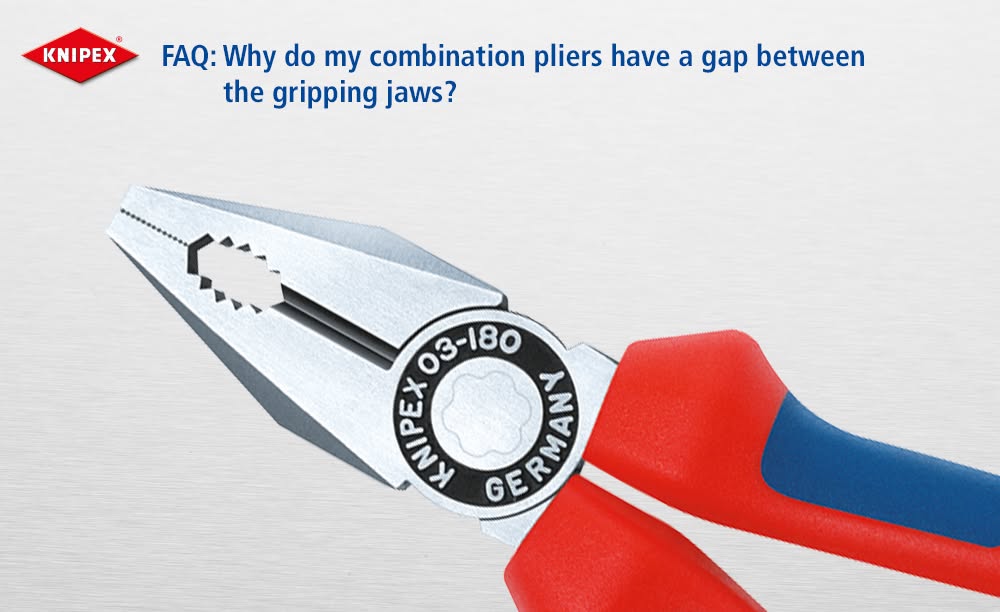
我们的组合钳按照 DIN ISO 5746 标准制造,这意味着您需要夹持 0.4 毫米厚的金属薄片。然而,纸张更薄,因此可能会滑过。
其原理如下:
组合钳将夹持和切割功能集成于一体。
就切割刃而言,它们必须完全闭合,才能可靠地剪断细线。
如果同时对夹持钳口提出同样的要求,就会出现“过度确定”的情况:
位于同一部件上但到共同枢轴点距离不同的两个功能面,必须同时达到最小值。这在理论上是不可能的——最终的判断完全取决于测量的精确度。
这样做也毫无实际意义:
如果新钳子出厂时就能使刀刃和夹持面完全贴合,同时闭合,那么在使用一段时间后,即使是高品质的钳子,接合处和/或刀刃也会自然磨损,导致刀刃之间出现缝隙,从而无法剪断细线。
在KNIPEX,我们优先考虑刀刃在剪断极薄零件时的持久安全性,而非夹持功能。因此,我们生产的组合钳,其夹持钳口之间都留有较小的缝隙。
Why do my combination pliers have a light gap between the gripping jaws?
Our combination pliers are manufactured according to DIN ISO 5746 which means that you have to pack 0.4 mm thick sheet metal. However, paper is thinner and can therefore slip through.
The background is as follows:
Combination pliers combine the properties of gripping and cutting in one tool.
With regard to the cutting edges, it is clear that they must close completely so that they can reliably cut even thin wires.
If the same requirement is now placed on the gripping jaws at the same time, this results in “overdetermination”:
two functional surfaces, which lie on the same component but have a different distance to a common pivot point, are to take up a minimum value at the same time. This is theoretically impossible – a judgment then depends only on how accurately one measures.
It would also make no practical sense:
If it were possible, when new, to match the cutting edges and gripping surfaces so that they close at the same time, then after a relatively short period of use, natural wear in the joint and/or on the cutting edge, which also occurs in high-quality pliers, would cause the cutting edge to stand up a gap, making it impossible to cut thin wires.
At KNIPEX, we have given priority to the permanently safe function of the cutting edge over the gripping function on very thin parts. That is why we manufacture our combination pliers with a small gap between the gripping jaws.